
Living in Houston, Texas: an expat guide
What to expect when moving to Houston
The locals will tell you everything in Texas is bigger and better than anywhere else and that’s because the native Texan is fiercely patriotic — sometimes amusingly so with their cowboy hats and boots — but they are deadly serious. They are a Texan first, an American second, and they honestly believe that everyone else wishes they were Texan too. You may grow to quite like this brash attitude, but on first contact it can feel a bit overwhelming.
Houston, on the other hand, is as diverse as any other large city. The outsider can fit in here with very little effort due to the sheer number of foreigners that move in and out all the time. One of the reasons for this influx is the oil and gas industry, with the big companies either based downtown or on the west side of Houston in an area known as the Energy Corridor.
Weather and climate
Arriving in Houston, it may surprise you just how green everything looks. Being on the east side of Texas and by the coast, Houston is far away from the deserts and canyons of the west and is regularly drenched with plenty of rain. The hurricane season starts in June and ends in late November, during which time there might be numerous ‘named storms’ (when storms reach tropical storm status — sustained winds of 39 mph — they are named) heading into the Gulf of Mexico, where it’s anybody’s guess where they’ll make landfall. July and August are also the hottest months of the year, with temperatures regularly creeping over 100 °F (38 °C).
Speaking English
English may be the first language here, but there are enough differences to make an impact. Tell your children to walk on the pavement here and you’ll be telling them to walk on the road (US speak is 'sidewalk'). Tell your son to wear a jumper and he’d be wearing a pinafore dress. There are many British words that a local here simply won’t understand, like nappy (‘Do you mean a napkin?’). You’ll get a blank look if you ask where the petrol station is — it's a gas station. And your mail comes from the post office and is delivered by the mailman (aka postman), but they don’t know what you mean by ‘post’ (note, however, that the mailman not only delivers your post, he will pick up any letters going out as well).
Houston is as diverse as any other large city. The outsider can fit in here with very little effort due to the sheer number of foreigners that move in and out all the time.
Just under half of Houstonians have Spanish as their first language and though most will also speak English, some won't unless you also speak Spanish.
Where to live in Houston
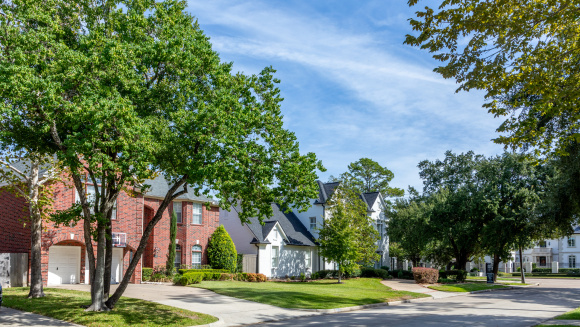
Finding somewhere to live is pretty easy. You can look online in advance to see the types of properties available and the price range. The hardest part is knowing which area to live in and it’s hard to decide that until you know which school your children will be attending.
You will most likely start out in a furnished apartment until your shipment arrives. The best thing to do is to find a realtor. In America, your realtor works for you, not for the landlord or seller. They will find appropriate properties, liaise with the landlord or seller’s realtor, and set up viewings to which they will accompany you.
Your realtor has access to information on all properties that are for sale in the area through a multiple listing service. Realtors freely view and show their clients each other's listings. The commission is a fee paid at closing by the seller which is split between the buyer’s and seller’s agents. If you find a property that's ‘for sale by owner’, it can be cheaper because the owner will not be paying a middleman.
Living near a school
Schools in Houston, as in most places in the US, are zoned into school districts and depending on where you live, you will be zoned to a particular school with quite specific boundaries. Private schools, on the other hand, will take students from any school district as long as they meet the entrance requirements (usually an evaluation to make sure your child does not have behavioural problems).
If your realtor seems a little elusive when you ask which schools are the best, and what neighbourhoods they're in, it's because in many states, realtors have been sued for saying a school is good (and then it doesn't turn out to be great for that family) or that it's in certain boundaries, and later a boundary change suddenly puts that family's house into another school district.
Home warranties
If you purchase or lease a house (as opposed to a leased apartment where all maintenance is included, right down to changing the light bulbs) you will most likely have a home warranty which provides repair or replacement cover for most items in the house. As with any insurance, there are different levels of coverage but even the most basic will usually prove to be worthwhile.
Getting started in Houston
You simply can’t function without a social security number (SSN) so make it a priority to get one. Opening bank accounts, setting up utilities, getting insurance, etc, all rely on your social security number as a cross-referencing tool. You must apply in person by appointment at the Social Security office, but once you have applied, you can call to get your number usually within a few days.
It depends on what visa you have as to whether you can have an SSN or not. If your visa allows you to work in the US, then you will be issued an SSN. If, however, you do not have employment authorization, you will be given a letter explaining that you are not eligible for an SSN. You will need this letter when applying for your Texas driver’s license. If you can’t get an SSN you will have to apply for a Tax Identification Number (TIN) for use when you fill out your US tax return.
Paying tax
In Texas there is no state income tax, only federal income tax, but everyone is required to complete their yearly tax returns. The US tax year is from 1 January – 31 December. If your taxes are relatively simple, you can do it yourself using one of the computer software packages that allow you to input all your figures and submit the return online.
If, however, your situation is a little more complicated — you have rental income or stocks and shares from your home country for example, you may want to have a tax accountant work it out for you.
Opening a bank account
Opening a bank account is easy enough as long as you have your social security number and some ID. Although you can do most of your banking online, if you do need to run to the bank not only can you go to the drive-thru ATM but they have drive-thru banking as well, complete with videophone to talk to the cashier.
Finding home help
Domestic help is quite common, usually a cleaner coming in once a week. There are many agencies providing cleaners, nannies, babysitters, etc, and most can be found in The Kid’s Directory, an online family resource guide. Most people rely on word-of-mouth recommendations and use an independent cleaner and gardener, which can work out much cheaper than employing through agencies.
Gardeners are very popular due to the heat in the summer months and the strict rules on keeping your garden neat and tidy set by many neighbourhood associations (they will send you a letter to ask you to edge your lawn more regularly if they feel it’s looking a bit untidy!). Prices are generally cheaper than in Europe as there are so many to choose from, so if you’re not happy with your first choice, it is very easy to find another.
Healthcare and insurance
Depending on your coverage you will be able to get most things dealt with on your insurance. Most companies also provide dental and limited optical cover. Once you have your insurance cover, you will have a co-pay amount which is the amount you pay for every doctor’s office visit and you will be asked to pay this on the day (some visits are excluded from this, like compulsory vaccine appointments for the kids).
As long as you use service providers that are covered by your particular insurance (and you must check this before you make an appointment) you will only be required to pay a small percentage of the bill (up to a total annual amount laid out in your policy, this total amount is called a deductible).
Buying a car
Car buying can be daunting but the car superstore CarMax is a safe option if you don’t want to haggle. All their used cars are inspected and come with a five-day money-back guarantee (in case you change your mind) and a 30-day warranty. They will buy back the car when you move on at Blue Book prices (which is the published guide price for the age, usage, and make of a car). Alternatively, just drive up and down Interstate 10 and you will find every make of car dealer you could want. Here, you will need to haggle.
Day-to-day living in Houston
It is possible to get around Houston without a car. There is an extensive system of bus routes and three light rail lines: the red line (North), green line (East End) and the purple line (Southeast).
Driving and licences
Driving in Houston can be busy but is fairly straightforward. The main differences are the four-way stop junctions and turning right on a red light. It is very important to be aware of the school zone laws. The area on a street near a school, or near a crossing leading to a school, will have a reduced speed limit (usually 20mph) and signs will make drivers aware of the possible presence of young pedestrians. School zone speed limits are often, but not always, only applicable during posted weekday hours near the beginning and ending of school and speeding fines are often doubled in these zones.
You have to wait 30 days before you can apply for a Texas driving licence. Obtaining a driver’s licence is easy in principle — you’ll need proof of identity, proof of vehicle registration, proof of vehicle insurance, and your social security number (essential for almost everything you do). You’ll need to take and pass a knowledge and practical driving test.
School buses and carpooling
School buses are available to children going to state schools and for a fee, some private schools. All school buses are bright yellow and have an array of flashing lights and pop-out stop signs (there is no excuse if you’re seen passing a school bus that has stopped to drop kids off — if you're caught, you will get a ticket).
Carpooling is the norm in most, if not all, schools here and drive-thru dropping and picking up. The latter is a very efficient way of getting to and from school without turning off your car’s air conditioning or waking napping younger siblings in the car. And though some schools have quite long lines to sit in, others stagger the dismissal times to make the pickup pretty quick.
Shopping
Shopping is often an indoor event; due to the heat and humidity, there are very few high street-style shopping areas in Houston. You either drive to the mall or drive to each store and park outside. You can do this pretty easily as parking is free and there are heaps of spaces. Most parking is outside and not in a multi-story car park (parking lot) which means your car will have reached about 120°F (49°C) by the time you get back to it, so parking once at the mall and doing everything you need to do there is much more comfortable than the individual store option in the summer months.
The other option is the drive-thru. You can drive-thru the mailbox, pharmacy, dry cleaners, ATM (cash point), Starbucks, and the usual fast-food places.
Sport, culture and entertainment
Houston can be a lot of fun. There are plenty of events going on from The Houston Symphony at one end of the spectrum, to the Houston Livestock Show and Rodeo at the other! This annual event, which covers a livestock show, a market selling Texan-style clothes, furniture and crafts, a fairground, food tents and a full-scale rodeo with bull riding, roping, and bucking bronco riding finished off with a music concert, is great for the whole family.
Sport is a big thing here and most families support one of the local teams, either football (that’s American football), soccer (that’s football as the rest of the world knows it), baseball, basketball, or ice hockey. Kids' sports are also big and you’ll find many families sitting on the sidelines or on the bleachers (bench seats) of one of the many leagues that go on year-round.
Eating out
Eating out is a major social event in Houston; it’s generally cheap, good quality, and there are more than enough restaurants to choose from. If this is your first visit to the States you will probably be shocked by the sheer quantity of food put in front of you. Don’t be afraid to ask for a ‘doggy bag’ or a ‘to-go box’.
Meeting new people
Meeting people can be fairly easy. Many expats stick together (probably because they know what it’s like to arrive in a new city and country) and before you know it you’ll be invited to playgroups, coffee meetings, and other social events. Organisations such as TANZOT (the Australian New Zealand Society of Texas) have regular coffee mornings, playgroups, book clubs, and child-friendly lunches as well as seasonal events.
Volunteering at your child’s school is a great way to get to know other people plus find out a bit more about the school while you’re there. Both state and private schools alike tend to rely heavily on volunteering parents and fundraising drives, so if you’ve got the time, you will be welcomed with open arms.
Entertaining children
Entertaining children is easy. Almost everywhere you go your children will be welcomed, too, with stroller parks, highchairs, and kids' menus. Amongst the many attractions, there’s the Houston Zoo, Battleship Texas, Blue Bell Ice Cream factory, Brazos Bend State Park (a must if you want to see alligators in the wild), Galveston Island, Kemah Boardwalk, Johnson Space Center, and George Ranch Historical Park to name a few. Many of the attractions are largely of the outdoor variety so plan carefully in the summer months when the temperatures can make being outside pretty miserable and take in something like the Children’s Museum or the Natural History Museum which are both excellent days out.
Most neighbourhoods have pools which are for residents only (keys or pool tags are provided). For obvious reasons (heat and no shade) the pools don’t usually get busy until later in the day/early evening but it’s a great opportunity to meet some of your neighbours. Parks are popular too, particularly with little ones, but beware that not all have much shade.
For pre-school activities try the popular story times; most bookshops, libraries, and even the Houston Arboretum and Nature Center all have planned story times. Other pre-school classes and activities abound with babies as young as two months advancing their development along to music and lots of parental encouragement. Some of these classes can seem a bit over-the-top but they’re a great way of getting ideas for playing with your baby/pre-schooler and you’ll meet others with similar-aged children.
The last word
Once you get over the culture shock and see past the stereotypes, you’ll find that Houston is a vibrant city full of opportunities. With a thriving, multicultural and international community, you can make the most of meeting people from all over the world.