Living in Paris: an expat guide
What to expect when moving to Paris
Before launching into the practical aspects of life in Paris, you must know a few things.
Some knowledge of French will be absolutely necessary. Even though more and more people speak English, old ways die hard and the viewpoint is that you, as a foreigner, must know some French and not the other way around.
Office hours tend to be long, mostly due to extended lunches and coffee breaks! So do not expect to waltz out of the office at 6 or 6.30 pm without raising a few eyebrows.
You will never be called by your first name and it is deemed impolite not to say ‘Madame’ or ‘Monsieur’ after ‘bonjour’ when entering a shop or addressing a stranger.
Punctuality is not a French forte. People are often late, and up to 15 minutes is still considered fashionably late.
Parisians dress well, not in a ‘haute couture’ way but with a certain ‘je ne sais quoi’. How you dress will tell others what they need to know about you. Yoga pants, running shoes, and hiking gear in public is inadvisable if you want to fit in.
You will definitely look Parisian if you eat the end of your baguette the moment you step out of the boulangerie.
You will truly experience how magical Paris is; you just need to take the city’s ways in your stride and enjoy all it has to offer.
Holidays
The other favourite French pastime, besides eating and drinking, is going on holiday. The average French will take five weeks' holidays, if not more, in the year and come August, the whole nation grinds to a halt. Paris will become deserted and most peaceful. It is one of the best times to walk around and discover the city although some shops and restaurants will be closed. Just make sure you do everything that needs to be done before August arrives.
Where to live in Paris
Paris is divided into 20 ‘arrondissements’ which spiral out numerically from the centre in the shape of a snail’s shell — the very heart of Paris is the 1er (first) ‘arrondissement’, home to the Louvre. Postcodes in Paris are made of an initial 75 (which denotes Paris) followed by a zero and further digits so the 2nd ‘arrondissement’ is 75002 and shortened to 2ème. These ‘arrondissements’ are almost like little towns in themselves that make up the capital.
Paris is sophisticated but nowhere near as diverse as London or New York, so do not expect to find an expat ‘community’ in the arrondissements. For that, you will need to head out into the suburbs, to the ‘intra-muros’ which denotes the limit between the city’s ‘arrondissements’ and the surrounding suburbs, known as ‘banlieues’. Most are perfectly genteel but others deemed ‘no man’s land’, the result of 1970s city planning which gave rise to low-income housing projects where social unrest can easily flare up. Do your research before venturing out.
Finding an apartment
Searching for an apartment in Paris can be quite a struggle. Space comes with a huge price tag, the bureaucracy is ridiculous, landlords are unscrupulous, and estate agency fees are astronomical. The struggle is real so if your employer can help, put them on the case as soon as possible as you may need a guarantor living in France to sign a contract.
The Paris market is notorious for the speed at which apartments get snapped up, so you need to be quick off the mark to be in with a chance. Terminology for property adverts can be confusing: the letters used are 'T' ‘type’ and 'F' ‘fonction’; they essentially have the same meaning. The letter is followed by a number that indicates the number of rooms (pièces) in the property, however, it excludes those that we would ordinarily include, eg a bedroom! So you have to assume that one or more of the rooms are reception rooms and bedrooms, which of course may be interchangeable. Also, the kitchen, bathroom, and toilet are not included as ‘pièces’, so need to be added to give the total number of actual rooms in the property.
Lastly, if the apartment you find is on a busy street, be sure to enquire if the windows are double-glazed (double vitrage).
Should an issue arise with your landlord, it is worth noting that as a tenant, you are well protected by the law, however, know that the concept of ‘wear and tear’ is quasi-non-existent and it is rare to get your full deposit back.
Getting started in Paris
Utilities, phone and internet
The energy market was deregulated a few years ago, allowing for many providers to offer highly competitive deals, so it’s worth shopping around with the ever-increasing cost of gas and electricity. All services are generally on a meter and if you are renting a flat, you don’t necessarily have to contract with the company that services the building.
There are several main telephone/internet operators. Unfortunately, it is rare to meet someone happy with their service, mostly because of customer service issues: installation is slow, technicians can be useless, and prices are not cheap. Competition is high, so take your time to shop around and don’t be afraid to play one against the other (if your French is good enough for that!).
Opening a bank account
There are plenty of national subsidiaries of international banks in addition to the national establishments, although finding an English-speaking employee might be a little more tricky. You will normally be asked for proof of ID, proof of address, and a letter of employment in order to open a bank account. Online banking, once set up, is easy and facilitates transactions when your branch is closed for the eternal lunch. Watch out for banking fees which are on the steep side and don’t expect wonderful customer service. Contactless payment (up to 50 Euros currently) is now the norm due to Covid and cheques are no longer accepted in shops.
Be prepared for bureaucracy
The French excel at administrative procedures and are shamefully contributing to considerable deforestation with the amount of paperwork required for the simplest process. You will also need to arm yourself with truckloads of patience to deal with the endless hurdles necessary to obtain any official document. Thankfully a few services have discovered the advantages of the internet (welcome to the 21st century I hear you say), which will save you hours of queuing and multiple visits at the ‘Sous –Préfecture’, the local administrative body.
Customer service is lacking
We could write a book about the lack of customer service in France, and particularly in Paris. It simply doesn’t exist and when you do come across it, savour it because it is rare. It’s very simple — it is either your fault or down to you to sort things out and prove that you are not in the wrong. The French are so accustomed to it that it doesn’t shock them, and you will soon grow used to it, even if forever frustrated by it.
Childcare and domestic help
You will find many options on offer, ranging from state or private nurseries to daycare centres for occasional or after-school cover. There are also an increasing number of bilingual centres cropping up which are worth checking out, besides the nanny or childminder option.
The best way to find domestic help is through word of mouth in addition to your local ‘boulangerie’ or mini-market where you will find ads, or online. The good news is that many of these options are state-sponsored; if employing domestic help or a childminder you will be eligible for a tax credit through the CESU, a state initiative to reduce illegal work.
Healthcare
The French healthcare system is good. Naturally, it has its flaws but it is efficient and it is accessible. You may have heard that the French are a nation of hypochondriacs — you will get why when you see the number of pharmacies on every street corner or the number of medicines your physician prescribes. You will need a social security number (numéro de sécurité sociale) and a ‘carte vitale’ to access services and receive state reimbursement for your expenses — all obtainable from the ‘Assurance Maladie’, whether you are employed or not.
Many physician doctors are now available on Internet platforms (eg Doctolib), which makes booking appointments a lot easier. For emergencies in the middle of the night, SOS Médecins is a phone call away 24/7.
Day-to-day living in Paris
‘Métro, boulot, Métro, dodo’ (tube, work, sleep). This expression is embedded in Parisian culture because people feel like all they do is take the tube, go to work, and come back home to sleep.
Public transport
Public transport in Paris is not fun — it is often overcrowded and only about 40 per cent of the network has refrigerated ventilation. The metro is used for trips within Paris, the RER takes you further out into the ‘banlieue’. Both are generally efficient until strikes bring the system to a halt — ‘c’est la vie’. Changing lines at the major stations can be time-consuming and confusing due to complicated directions. Paris is a very walkable city so don’t be afraid to jump off a stop earlier to avoid the extra 15-minute commute time. Being state-owned, prices are accessible with many types of season passes available (carte Navigo).
Driving
Parisians have no patience most of the time and even less when behind the wheel. Honking is forbidden yet almost an inborn reflex, and civility is completely thrown out the window. Motorbikes, bicycles, and electric scooters zoom around as if the road solely belonged to them, making the experience even more nerve-racking.
Navigating is also fun; you can suddenly go from the widest avenues to tiny streets arranged around complex and very frustrating one-way systems. There is also the ‘priorité à droite’, a nonsense of a rule where you must yield to traffic coming from your right. Oh, and forget driving at rush hour — you will want to see a cardiologist on a regular basis.
If you are precious about your car, you might as well forget having one as every vehicle gets bashed and scrapped, mostly thanks to the remarkable parking abilities of the locals. You will regularly find your car wedged between two others, leaving you in tears of rage. Thank goodness for power steering!
Cycling and taxis
Pollution being one of the worst issues this city faces, the administration has made it their mission to turn Paris greener by substantially increasing cycling lanes and making some major roads pedestrian. On pollution peak days, a differential driving system comes into force, inciting Parisians to leave even or uneven number-plated cars home and use public transport. You will also need a ‘CritAir vignette’ which rates how polluting your vehicle may be.
The advent of the Vélib bicycles has changed Parisian streets and life considerably. Rent a bike anywhere in Paris for about €2 and return it hours later at one of the self-service bike stations scattered throughout the city. If you are brave enough to overcome the perils of crazy taxi drivers and honking buses, you will have become closer to being a true Parisian.
Taxi drivers are generally sullen and unfriendly. It is often difficult to hail one in the street, the rule being that taxis will only pick you up at the rank — when there are some! Therefore, Uber has caught on very well, however, only the higher end of their service is available in the city.
Eating out and going out
With close to 10,000 restaurants, you will sometimes struggle to choose where to go. From the Michelin-starred to your local neighbourhood restaurant, there is something for everyone’s taste, ranging from traditional French cuisine to international fare. Gratuity is usually included in the bill, and although waiters are paid a living wage, tipping is still customary. You would normally leave a symbolic euro for a café, about €5 for a meal at a ‘brasserie’ and up to 10 per cent for good service at a decent restaurant (naturally this will vary on your personal preference, service received, and the establishment in question).
Most waiters will speak English; however, always best to make a first attempt at a ‘bonjour’ — this will save you their ire and service will be quicker. Meals are sacred in France and before you know it, you will find yourself sitting at a terrace for over an hour because nothing is rushed when it comes to food. Fast food is on the rise but most office workers will take at least an hour for lunch.
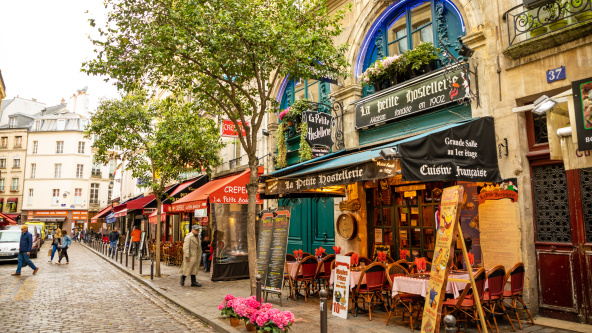
Paris would not be Paris without its multitude of cafés where you watch the world go by whilst sipping a coffee. Beware you will pay more if sitting outside on the pavement than on the inside or even standing at the counter.
Food shopping
As you would expect, there is no difficulty in finding great produce in Paris. In fact, you could spend all day food shopping. Each arrondissement will normally have its own little market for fresh fruits and vegetables, usually held on a Saturday morning. Be careful to check prices as they can sometimes be on the steep side. Add to that local mini-markets of big supermarket brands, local bakers, butchers, wine cellars, smelly cheese shops and you will never want to leave, (and will potentially gain a few pounds).
The city has many specialised food shops which will ease off homesickness craves or just satisfy any adventurous gastronomic impulses. Shops are closed at lunch, Sundays, and sometimes Mondays, although this seems to be changing little by little. Even if tradition is king in this country, supermarket delivery has grown exponentially and you will have no trouble finding a reliable service in your area.
If you think frozen foods are not on your radar, think again. Picard is a lifesaver — it offers great quality ingredients such as vegetables, fish, or meat as well as tasty prepared meals at affordable prices.
The last word
Once you have grappled with all of the above, you will truly experience how magical Paris is, you just need to take the city’s ways in your stride and enjoy all it has to offer.