Living in Zurich: an expat guide
What to expect when moving to Zurich
Currently, about 32 per cent of the local population is non-Swiss, making it a very international community.
The local language is Swiss German (Schweizerdeutsch), but some people have lived here for 20 years without speaking it. You can get by speaking English although you unquestionably miss out on a lot of good experiences if you don’t at least try. If you can, get to a class and learn some survival German before you get here. Then, help your children with their German homework and learn it yourself while you’re at it. Making an effort goes a long way with the Swiss.
Switzerland is naturally beautiful. It’s a country of mountains and lakes. In the summertime, it is incredibly green. In wintertime, it looks pretty much like a Christmas card. OK, it can get windy and rainy sometimes and there are some years when it’s very foggy for long stretches, but that’s mostly in the valleys. In case of extreme fog, take the train to Arth Goldau and then the cogwheel train to the top of the Rigi mountain. You will be above the fog in no time. Bring sunscreen.
Zurich Metropolitan Area
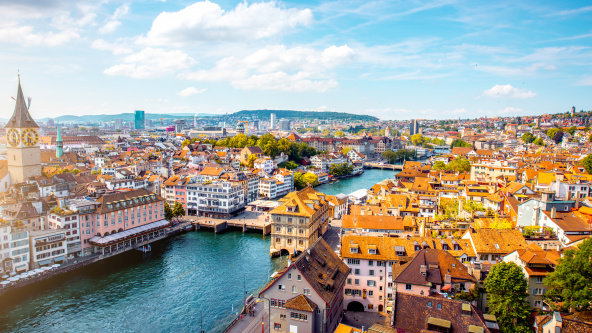
Zurich itself is actually quite small with only about 400,000 inhabitants. The Zurich Metropolitan Area (ZMA) is home to about a further million and loosely includes the neighbouring communities of Aarau, Winterthur, Rapperswil, and Zug. Draw a circle encompassing these four cities and you’ll have a reasonable commuting area for working in Zurich.
From each and every one of those towns, there are at least four trains per hour that will get you to downtown Zurich in about half an hour. All public transportation here — the trains, trams, and buses — are safe, clean, and unbelievably punctual. If that schedule says the train leaves at 14:08, it will leave exactly at 14:08.
Within those aforementioned parameters, all of the communities are connected by a system called S-bahns. These are commuter trains and everybody takes them. Once you get to your destination, there will be buses co-ordinated to the train schedules. Regular train service generally runs from 5:00 am till around midnight but on the weekends, there are night commuter trains at 2:00 and 4:00 am. In Zurich, the main station is often busier at 2 am than it is at 2 pm.
The public transportation is so good in this country that there are people who never buy a car.
Where to live in Zurich
The one big glitch in all this paradise is housing. Within Zurich city and in the area between Zurich and Rapperswil (both sides of the lake), housing is very scarce and very expensive. Finding a free-standing house or even a semi-detached one in this area can not only be daunting, but it can also be close to impossible. Be prepared to move into a house or apartment that is noticeably smaller than you’re used to.
For this reason, the areas in the directions of Aarau, Zug, and Winterthur are becoming increasingly popular. All of these areas have international schools. The lake communities of Zurich have traditionally been the stronghold of the international community, but that is changing. Winterthur area has beautiful rolling hills, Aarau area is a valley peppered with Habsburg castles, and Zug is a lovely town located on its own lake and it is a tax haven.
Recreation and entertainment in Zurich are phenomenal. You could eat out every night and never stop discovering new great restaurants.
Getting started in Zurich
From an infrastructure point of view, getting set up here is fairly simple. Rental apartments and houses are required by law to be clean and ready to move into. If something is not working, the landlord is required to fix it at his cost. All units have fitted kitchens and bathrooms. Many have washers and dryers. Most already have phone, TV and internet connections built in. You just have to let the provider know when to hook you up.
After an easy two-hour trip to any bank, you will be set up with your accounts, your debit card, and your credit cards. You do have to register with your local community within 10 days of moving in.
Many people hire a relocation specialist for two days to help with reading over the rental agreement and doing the move-in inspection, registering with the community, switching driving licences and buying a highway sticker, connecting phone, TV and internet, organising mandatory health insurance, purchasing public transportation passes and visiting the bank. It is really useful to have someone who speaks German and English help you out with these things. But after those two days, you should be up and running.
Day-to-day living in Zurich
Shopping
Shopping here is fantastic. Zurich used to have a reputation for being very expensive, but prices in London or New York are generally higher. If you stick to the Bahnhofstrasse, the main shopping street, you will find some very pricey options. Every major designer is represented here and visiting the specialty shops makes you feel like a princess.
Downtown Zurich is destination shopping but don’t forget the parameter towns. Aarau, Winterthur, Rapperswil, and Zug are all beautiful towns from the medieval ages that have preserved their historical areas for pedestrian zone shopping. They are great towns to take visitors to.
Many people, when they first move here, gravitate to the two big department stores, Jelmoli and Globus on the Bahnhofstrasse, to buy food because you can find ingredients from around the world, albeit for a shocking price. These stores are great for special occasions and for luxury ingredients.
For everyday needs, however, there are many ways to get around going broke. Most newcomers think that there are only two supermarket chains, Migros and Coop. They are dominant to be sure, but the German chains Spar, Aldi, and Lidl have moved in to provide some healthy competition. There is also Otto’s which has great prices on things like shampoo and laundry soap.
But the fun begins when you start getting to know the neighbourhoods. There are scores of Asian markets where you can buy every sauce, spice, or special ingredient known to man at a fraction of the price you would pay on the Bahnhofstrasse. The Turkish community seems to have cornered the vegetable market. The produce is very fresh and lower priced than in the supermarket chains. And every town has weekly farmer’s markets with stalls filled with luscious vegetables, artisanal cheeses, speciality meats, organic jams, and fresh flowers. There is even a speciality foods market in the Zurich main station every Wednesday except during December when it is pre-empted by the Christmas market.
Meeting new people
To help yourself navigate the endless possibilities, get in touch with the American Women’s Club. You don’t have to be American to join. In fact, Zurich is loaded with expat organisations, especially English-speaking clubs and groups ranging from the expat Zurich forum to the British Swiss Chamber of Commerce. The Zurich International Women’s Association has a good website with lots of activities to get your social life started.
What to do and what to see
Depending on how active you are, there are English-speaking events, ranging from English stand-up comedy to madrigal singing, taking place every day of the week in the ZMA. And don’t forget that most of the English-speaking schools have very active parents’ associations.
Recreation and entertainment in the ZMA are phenomenal. You could eat out every night and never stop discovering new great restaurants. In the city, there are about 20 movie theatres that show movies in the original language (usually English) with German and French subtitles.
Zurich has a world-class opera and symphony but is also a stop for every major popular band that’s touring. The museums house everything from fine art to watches to a woolly mammoth. City festivals range from the medieval ‘Sechseleuten’ where a three-metre tall snowman effigy is burnt to chase away winter to the ‘Street Parade’ which annually draws a million techno music lovers to the streets.
In summer, there are jazz festivals, marathons, carnivals, fan zones, fireworks, and Swiss Independence Day. In winter, snow sports (and all of the après sport activities) rule. Remember, you will be living within two hours of the best ski resorts in the world. For those less sports-minded, winter is the season for formal dress balls and galas. For the more casually inclined, there are plenty of clubs and they stay open until 4 am on the weekends. And you can go everywhere by public transportation, in the worst case a taxi, so having a glass of wine isn’t a worry.
The last word
Truly, this once-staid fortress of serious secret finance did something wild in the last 15 years. It got hip! It got fun! It got open and lively. And it throws its arms open and welcomes you. Welcome to Zurich!