
Faith schools in the UK
What is a faith school?
Faith schools are primary and secondary schools with an affiliation to a particular religion or faith-based organisation. They are still state-funded, like academies and community schools, but tend to have greater autonomy over what they teach.
Faith schools have a reputation for strong communities, traditional principles, and positive academic results making them an attractive prospect for many families on the hunt for a good state school. They are subject to the same standards and inspections as any other state school. Collective worship is usually a daily feature and many schools prioritise the admission of pupils whose parents are regular participants in the school’s religion.
What does ‘designated religious character’ mean?
‘Faith school’ is an umbrella term which takes in all schools with what the government calls a ‘designated religious character’ or ‘religious ethos’. In Scotland ‘denominational school’ is more commonly used. These schools include voluntary aided, voluntary controlled and foundation schools as well as faith academies.
This array of terms is not hugely important as far as most parents are concerned. Although faith academies have more freedom to set their own curriculum, the differences between these school types tend to have more to do with ownership of buildings, organisational structures and funding arrangements than with what happens in the classroom.
37 % of state primaries in England are faith schools
How many faith schools are there?
There are nearly 8,000 mainstream faith schools in the UK – that’s about a third of all state schools. They’re a feature of the education systems in England, Wales, Scotland, and Northern Ireland.
Types of faith schools in England
England has the greatest number and variety: 37 per cent of primaries and 19 per cent of secondaries are faith schools. More than two-thirds of the faith schools in England are Anglican with most of the rest Roman Catholic. There are also 52 Jewish, 35 Muslim, 13 Sikh, and seven Hindu faith schools.
Do you have to be religious to go to faith school?
You do not have to be religious although it depends on how you define ‘religious’ and which schools you’re interested in.
Faith-based oversubscription criteria explained
All Catholic schools and some Anglican schools put a faith condition in their oversubscription criteria. This is the part of their admissions policy that, in the event of receiving more applications than they have places, allows the school to handpick pupils according to whether their parents regularly attend church. Documentation, such as baptismal certificates and letters from faith leaders, can also be a factor in getting a place at such schools.
Some faith schools admit up to 100 per cent of their pupils according to faith but many do not. The Church of England has plenty of schools which don’t admit by faith although the final decision usually comes down to the school itself and demand for places at the school. Faith schools are often a popular choice so it is accepted that the oversubscription criteria will come into play.
Admissions policies
If you’re keen on a faith school for your child, make sure you study its admissions policy. You can also find out how far down the oversubscriptions criteria the school has gone in previous years’ admissions rounds by asking the school or local authority. The Good Schools Guide’s explanations of primary school admissions and secondary school admissions are helpful for any parent embarking on the process.
What is taught in faith schools?
In England, the National Curriculum is compulsory in maintained schools, including voluntary aided, voluntary controlled and foundation schools, which together account for more than half of all faith schools. These schools must teach the National Curriculum, although they have some flexibility over how individual subjects are delivered. Academies and free schools, including faith academies, are not required to follow the National Curriculum and are free to devise their own curriculum, subject to the terms of their funding agreement.
Faith academies and curriculum freedoms
Religious education (RE), however, sits outside the National Curriculum and is compulsory for all pupils aged 5 to 16 in state-funded schools, including academies, unless a parent chooses to withdraw their child. In schools without a religious character, RE must follow the ‘locally agreed syllabus’ drawn up by LAs, which reflects Britain’s Christian traditions while also taking account of other principal religions. Faith schools are permitted greater latitude. In voluntary aided schools, RE is taught in line with the school’s trust deed and the wishes of the governing body. Voluntary controlled and foundation schools normally follow the locally agreed syllabus, unless parents request provision in accordance with the school’s faith. Faith academies (and free schools) are not required to follow the locally agreed syllabus and can teach RE as they see fit, although many still choose to include teaching about other faiths. Despite this autonomy, the government states that matters informed by religious doctrine, such as creationism, must not be presented as fact in lessons.
What are the advantages of faith schools?
Faith schools are popular with many families because they provide a curriculum and ethos that is in tune with home life. Community events and feast days get a bigger billing than they might in a normal LA-run school or academy. Schools may also be closely linked to a particular place of worship which helps foster a sense of community. This is particularly appealing to minority groups who want their children to grow up with a sense of cultural and religious identity.
Do faith schools get better results?
Faith schools are also attractive because they are perceived as being more academic. The data supports this. At Key Stage 2 in 2023, the percentage of children in England reaching the expected level of reading, writing and maths at faith schools was 61.5 per cent. In non-faith schools it was 59.7 per cent. In secondary schools, using the GCSE Attainment 8 measure, faith schools scored 49.0 per cent and non-faiths scored 46.2 per cent. The value-added Progress 8 measure shows faith schools scored 0.13; non-faiths scored -0.06 (below the average score for England of -0.03). Of course, this doesn’t exactly mean that religion in school equals brighter children. Socio-economic forces are at work here, read on...
Are faith schools controversial?
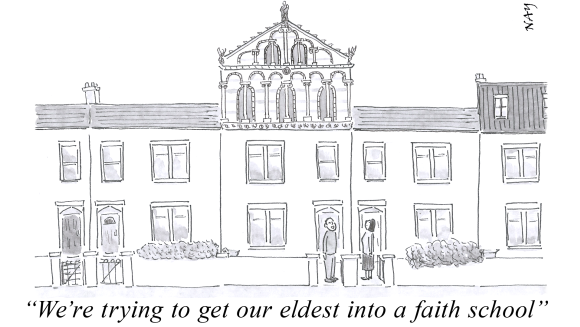
Some people consider faith schools to be a bad thing. Both Humanists UK and the National Secular Society have campaigned for an end to them and point to, among other things, the preference given to churchgoers over other families as being socially selective and divisive. They say such admissions practices result in children being unable to attend their local state school and breed resentment.
In a 2016 report, the Education Policy Institute stated that ‘faith schools have, on average, fewer pupils that are eligible for free school meals than the areas in which they are situated’. The bigger picture reveals a similar disparity – in 2023, 25.5 per cent of children at non-faith schools were eligible for free school meals whereas the figure at faith schools is 20.2 per cent. As such, the criticism levelled at faith schools is similar to that aimed at grammar and private schools: that the teaching is little better than the alternatives but rather the pupils are more likely to come from middle-class homes with parents who know how to play the system and are committed to their children’s education and supporting their school.
Faith schools FAQ
What is a faith school in the UK?
A faith school is a state-funded primary or secondary school with a religious character. It may reflect a particular faith in its ethos, worship and admissions policy.
Do you have to be religious to attend a faith school?
Not always. Some faith schools prioritise children from religious families when oversubscribed, but others admit pupils regardless of faith.
Are faith schools free?
Yes. Faith schools are part of the state education system and do not charge fees.
How do faith school admissions work?
If a faith school is oversubscribed, it may give priority to children whose families meet certain religious criteria, such as regular worship attendance.
Do faith schools get better exam results?
On average, faith schools achieve slightly higher results than non-faith schools, although this is strongly influenced by socio-economic factors.
Are faith schools controversial?
Critics argue that faith-based admissions can be socially selective, while supporters point to strong communities, ethos and academic outcomes.