Could tutoring harm my child?

What are the disadvantages of tutoring?
Sending pupils to private tutors for up to two hours after school is tantamount to ‘child abuse’, claim some professionals working in children’s wellbeing – and they’re not the only ones speaking out. Educationalists have also called out pushy parents who subject their children to additional evening teaching, sometimes as young as 4 years old and often against their will.
Critics point to a number of potential disadvantages of tutoring, particularly when children have nearly every spare moment occupied with out-of-school work or if they’re being pushed towards unrealistic academic goals.
It’s no better later on in their childhood, when children are often tutored day after day so they can scrape into a grammar school or nudge up their GCSE grades.
Can too much tutoring affect a child's wellbeing?
Headteacher after headteacher tells us it devalues their teaching, skews the playing field and causes children to miss out on the likes of swimming, football, Scouts, ballet or simply playing. Either that or they’re just plain exhausted because they’re trying to fit all this in on top of hard-core one-to-one learning or tuition centres out of school hours. If they are falling behind at school, it’s no wonder, they say.
Can tutoring undermine confidence and independence?
Moreover, it can confuse a child no end if, say, their maths tutor uses different methods to solve mathematical problems.
And that’s before we’ve even explored the effect on their mental health. ‘You’re just not good enough!’ is the message, loud and clear, to some of these children who, actually, are doing perfectly fine.
One of the less obvious disadvantages of tutoring is that it can also foster a culture of academic dependence – a child feeling they can’t do their homework or prepare for the next test without their tutor to help.
The downsides of tutoring for grammar school admissions
A criticism of intensive 11-plus tutoring is that it can help children secure places at schools whose academic pace may ultimately prove challenging. Despite earning that place, there’s nothing to celebrate here – the child may struggle when they find they can’t keep up with the academic pace, and school will be miserable.
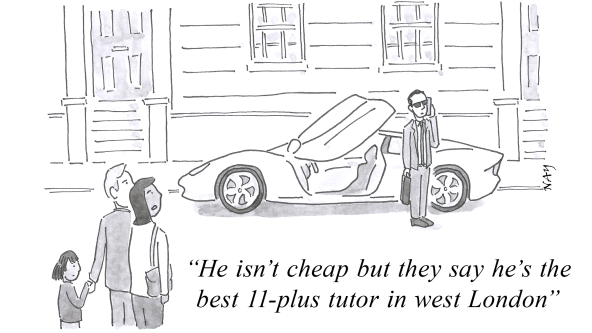
The dramatic increase in private tutoring is less a case of children actually needing a helping hand academically and more a case of tutoring becoming the new normal, say critics. Once a parent hears of little Johnny or Amelia having tutoring, that’s it – they’ve googled their nearest tutor agency or tuition centre before they’re even out of the school gates. If entrance exams are on the horizon, tuition hours are snapped up quicker than organic sourdough loaves fly off the shelves at Waitrose, especially in London and some of the home counties.
Send your child off to sing in a choir or play football – or just go for a walk in the woods with them, goes the advice of opponents of tutoring. Much is reported on the pressures children already feel and school hours can be long – why add to them?
What are the benefits of tutoring?
Tutoring is no longer the dirty word it once was. We increasingly see schools and teachers recommending and working with tutors (and don’t forget many teachers are themselves tutors out of school hours). In addition, more tutor agencies are working directly with – and even in – schools. The Covid-19-era National Tutoring Programme is no longer running but helped accelerate this trend, and many schools continue to use tutoring as one of a range of academic support interventions.
How tutoring can help children who are struggling academically
Many parents rave about tutoring too. It’s not hard – particularly the closer you get to London – to find hordes of them rhapsodising about how extra tuition made all the difference to their offspring’s educational achievements, giving their previously underperforming children a track record of success.
There will always be children who struggle with a particular subject, even if they go to the best school with the smallest classes. No school can give every single pupil all the attention they need and sometimes that teacher’s approach won’t quite work for that individual child. This, they claim, is where tutors can prove invaluable.
It’s no coincidence that maths and the sciences are the most commonly tutored subjects – these are the subjects children are more likely to struggle with. So what’s wrong with giving kids an extra hour here or there in these or other subjects to help reinforce what they’re learning in class or to give them new ways of getting their heads round difficult concepts? So goes the argument.
Tutoring for children with SEN
Children with SEN can particularly benefit from tutoring, particularly if those tutors are trained in neurodiversity. Not only can the tutoring be tailored to suit your child’s speed and style of learning, but the tutor can explain concepts in different ways and make use of things like visual mind maps.
Can tutoring improve exam performance?
Parents whose children already shine in the classroom are not immune to singing the praises of private tutoring either – mainly to perfect their revision and exam techniques. In the uber-competitive world of getting into top schools and universities, this can make all the difference, they say. And yes, that tutoring may need to start young, they’ll tell you – if only because getting your child into the right prep school can have such an impact in the longer term.
It’s not as if all children are inevitably unwilling participants – far from it, with parents and tutors reporting that in many cases, it’s the children themselves requesting extra help. And it’s not as if tutors take on any child – good tutoring firms will tell families where they think there’s no need or benefit.
In short, say private tuition enthusiasts, what parent would stand by when they can afford to give their child a boost?
Parents asking ‘Could tutoring harm my child?’ are often looking for a binary yes-no answer. The reality is more nuanced. The disadvantages of tutoring tend to arise when the tutoring is excessive, unwanted or poorly targeted. When it is proportionate, goal-focused and the child is a willing participant, tutoring can be a valuable educational tool.
Checklist: questions to ask before hiring a tutor
Don’t tutor too young – we think there is no place for tutoring children aged 4
Does your child really need tutoring? – if you haven’t identified a goal, you shouldn’t be doing it
Does your child want to be tutored? – at best, they should want it, and at worst, they should be on board with it
Do a sense check on the number of hours – these children are at school all day, give them a break
Check on their confidence levels – tutoring should improve confidence, not make them feel worse about the subject
What is all this tutoring replacing? – if they have to ditch swimming that they love for tutoring they hate, take a step back and reassess
Beware of spoon feeding – children who depend too much on tutors can’t become independent learners