
How to pay for a private school education

As a financial advisor at Amber River SFIA, I routinely speak to parents who are committed to providing a private education for their children, but who only have a partial understanding of the long-term financial commitment involved. Helping families prepare for that commitment is a large part of my role.
Since January 2025, independent school fees have also been subject to VAT, increasing the cost for families. And VAT is only part of the picture. As The Good Schools Guide’s analysis of the future of private school fees found, fees have historically risen faster than inflation, making long-term financial planning more important than ever.
School fees planning is rarely just about finding enough money to meet next term’s invoice. It is about balancing educational aspirations with wider financial priorities and ensuring today’s decisions do not create tomorrow’s financial pressures.
Average day school fees (including VAT) now stand at around £7,500 per term for day pupils and £18,000 per term for boarders, although costs vary significantly between schools and regions. For many families starting the process now, the cost of independent schooling for a child’s whole education may cost between £400,000 and £500,000. At the higher end, the equivalent at some leading day and boarding schools can exceed £700,000. (Sources: ISC Annual Census and The Good Schools Guide)
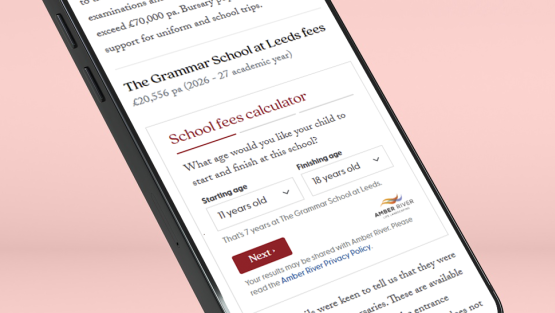
Understanding where your preferred schools sit within that range is the first step towards building a realistic financial plan. Good Schools Guide reviews now include an Amber River school fees calculator (see the Money Matters section) that can help estimate the likely overall cost based on your chosen school and educational pathway.
Making private education more affordable
Mixing private with state
Many families pick private schooling for just one part of their child’s educational journey. You may find you live close to good state primaries and that building a savings plan or investing capital before secondary school is the most prudent thing you could do. Either way, planning ahead can make a huge difference. Some parents begin building a dedicated school fees fund years before they actually need it, investing regularly and allowing savings to grow over time. Even a relatively modest monthly contribution can help reduce the pressure of future fee payments and lessen the need to draw heavily on monthly income when children reach school age, especially if started early.
Other parents are targeting a place at a state grammar school and may consider paying for prep school as the ideal way to prepare their child for the 11-plus assessments. It’s also possible to delay private education until sixth form, allowing families to focus their financial resources on giving their child the best possible preparation for A levels and university. Increasingly, many are taking a hybrid approach rather than assuming private education has to mean the whole 14 years, from reception to sixth form.
Paying school fees in advance and payment plans
Many schools can help when it comes to managing the fees you pay. Some offer reductions if you can pay fees for the whole year (or even the duration of your child’s education) up front. Other schools also accept monthly payments or offer payment plans to help parents stretch the costs across the year. This can ease the pressure of the termly payments and help with household budgeting.
Building a school fees investment strategy
By starting early and making regular contributions into tax-efficient savings and investment vehicles, parents may be able to benefit from long-term investment growth before fees become due.
Depending on individual circumstances, this could include stocks and shares or junior ISAs, general investment accounts, investment bonds or pension planning as part of a wider family wealth strategy. A financial planner can help structure withdrawals in a way that seeks to minimise unnecessary tax liabilities while ensuring funds are available when school fees arise.
For some families, the most effective solution is not simply identifying where the money will come from each term, but creating a long-term strategy that coordinates savings, investments, income and future financial goals.

Accessing capital
If you’ve explored other avenues but still require additional funds in the short term to cover school fees, releasing capital from your assets could be an option.
Using property assets
This might involve making use of property assets. If you have equity available, you could restructure your current mortgage lending or use a further advance to access additional funding.
Help from grandparents and equity release
Grandparents may also be willing to realise the value of existing assets which may ultimately be passed on through inheritance, such as property, through equity release.
Equity release is available for those aged over 55 and requires specialist advice.
Understanding the long-term implications
Before releasing capital from your assets, it’s a good idea to speak to a financial planner who can help you assess the long-term implications on your finances and ensure the decision aligns with your overall goals. Releasing capital will reduce the value of your estate and could affect your eligibility for means-tested benefits.
Cashflow modelling: seeing the bigger picture
School fees should never be considered in isolation.
At Amber River, we use sophisticated cashflow modelling to help families understand how school fees fit into their broader financial future. Rather than looking solely at the next term’s fee invoice, we examine the years ahead and model different scenarios. This allows us to stress-test a family’s plans against factors such as school fee inflation, changes in income, early retirement, illness, incapacity and market volatility. The aim is to understand whether a school fees strategy is likely to remain sustainable under a range of real-world scenarios. We would also test the strategy against the family’s existing protection arrangements, such as life assurance, to understand how these could help support the plan if circumstances change.
For many families, seeing the numbers mapped out visually provides confidence that private education can be funded without compromising other important goals such as retirement planning or future family wealth.
Why professional school fees planning can make a difference
School fees planning is rarely just about finding enough money to meet next term’s invoice. It is about balancing educational aspirations with wider financial priorities and ensuring today’s decisions do not create tomorrow’s financial pressures.
A financial planner can help you understand the full cost of private education, build a sustainable funding strategy, and use cashflow modelling to assess the long-term impact on your finances.
Whether you’re planning years in advance or preparing for fees that are just around the corner, a structured plan can help you make informed decisions with greater confidence and peace of mind.
When it comes to planning for school fees...
Remember that every family’s circumstances are different. In this article, we have highlighted just some of the options that families may wish to explore when thinking about private school fees.
Amber River specialises in financial planning and investment strategies to help families prepare for education costs. We don’t provide advice on school bursary applications, fee assistance schemes offered directly by schools, student loans or other forms of borrowing.
If you are considering these options, The Good Schools Guide has a team of consultants who can advise on scholarships and bursaries, and we would encourage you to speak directly to the relevant school or specialist provider regarding fee assistance schemes. We are, however, happy to help you understand how any funding arrangements may fit within your wider financial plan and long-term goals.
About the author

Cheryl Warner is an independent financial planner and advisor at Amber River. As well as expertise in school fees planning, she specialises in pension and retirement planning as well as ethical investing, equity release and inheritance tax planning. Cheryl started working as an advisor for Amber River SFIA (part of the Amber River group) in 2012 and has since built up a wealth of experience devising bespoke advice for clients looking to make sound decisions with their finances.

Amber River
The Amber River Group comprises almost 200 independent financial planners and is trusted by professionals, individuals, families and business owners. The Good Schools Guide has partnered with Amber River to draw on its expertise in financial planning, helping our readers understand the financial implications of private education and planning for school fees.