Montessori schools
What are Montessori schools?
Pioneered in 1907 by Maria Montessori, Italy’s first female doctor, Montessori education was originally developed to teach poor Italian children. Her philosophy was that ‘the essence of independence is to be able to do something for one’s self’.
Her child-led, holistic approach remains the key feature of Montessori schools and nurseries, where children in mixed age classrooms are free to choose between a range of activities in ‘prepared environments’ with specialised materials. The focus is on practical, independent learning at the child’s own pace.
There are over 20,000 Montessori schools and nurseries across the world. In the UK alone, there are around 700, mostly based in England, particularly in and around London, with over 30,000 pupils. Although mostly confined to pre-school and early years education, there are some Montessori junior schools and a few senior schools too.
What is the Montessori method?
Child-led learning and mixed-age classrooms
In a Montessori classroom, you should see children moving freely around the classroom, wholly involved with and absorbed in their learning and guided (not taught) by staff. Older children join forces with younger children.
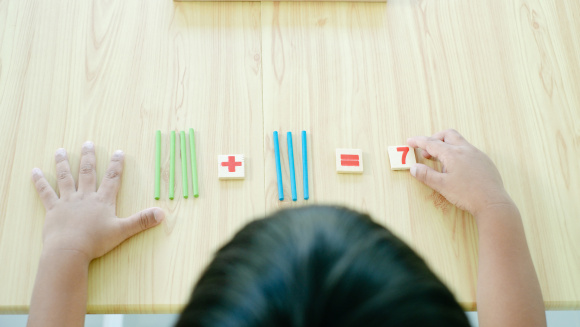
Early years classroom materials include those that sink or float, link or fit together. Children learn letters by cutting them out of sandpaper and tracing them with their fingers, and numbers by forming bead chains. Materials are mostly natural – wood, glass or china – rather than plastic.
Montessori education at primary and secondary level
At primary and secondary level, learning is more curriculum based, although even this is holistic. Instead of isolating subjects, the idea is for children to explore the big picture of how the world, history and science are linked – with freedom to follow their own interests within a structured framework and within a carefully curated environment. No fixed lesson times, no set assignments and no formal testing. You might see one child working out how to square a number, another comparing prehistoric cultures and another researching river systems. Again, classes are mixed ages – often 6-9 and 9-12.
Secondary school pupils tend to work towards a limited range of GCSEs of their choice, along with other qualifications like Art Awards. To achieve this, learning becomes more academically rigorous, but still focused on a supportive, independent learning experience.
Who does a Montessori school suit?
Children who are curious, creative and enjoy learning through doing. Children who need confidence can also benefit from the individualised approach, the focus on strengths and an environment where they learn from each other.
Montessori can also be an excellent environment for neurodivergent children including those with ADHD, autism or dyslexia due to the calm, self-directed, multi-sensory environment. However, it’s important to note that some children may prefer a more overt, rigid and predictable structure.
How to choose your Montessori school
Look for a mixed-age environment that feels calm, orderly and inviting, with natural materials and engaged, respectful children working on different tasks in their own time. Ideally, there should be an outdoor space.
The school or nursery should be accredited, and staff should be trained by a specialist Montessori training centre and be working one-to-one with children rather than using traditional didactic whole-class teaching from the front.
Take note of the atmosphere too. If the classroom feels chaotic, loud or messy or children are all doing the same activity, it’s not true Montesssori.
Further information about the Montessori method and Montessori schools can be found here: